Popular Posts

Showing posts with label surface pattern design. Show all posts

Monday, October 5, 2026

Update! The Beginning of Pastel Plaid Collection is done!

A photo of a teen room with wallpaper that's like a simple plaid in pastel colors
         Pastel Plaid© collection is now available as fabric or wallpaper in my Spoonflower shop, HERE. 
 

A client recently asked me to design a soothing criss-cross pattern for a nursery she was going to be decorating. Something pastel, pleasant to the eye that gives off a light and airy feeling. So, I immediately got to work. I looked through my floral collection for inspiration and jotted a few notes down with design ideas and went to bed. Side note, doesn’t your brain work well when you get in bed? Mine does. I have my tablet next to the bed so I can make notes of colors, shapes and ideas before they vanish. Also, there’s decades of design ideas in my mind. I enjoy letting my mind wander about all the products this next collection will end up covering.

The next morning I made my coffee and headed out to my garden. These three flowers jumped out at me as if to say; “pick me!” The first one is the favorite Johnny Jump Ups, the second is the Asiatic Day flower - which many consider a weed, but I beg to differ! It’s beautiful, cleans spoiled copper mines and is used in traditional Chinese medicine and has been used as a dye in Japanese woodcuts. And, the last flower of course is our beloved Peony. These three were quite pleased that I chose them for my next collection. I photographed them from every angle, told them how special they were and how privileged I felt to have them grace my gardens. Then I got to work.
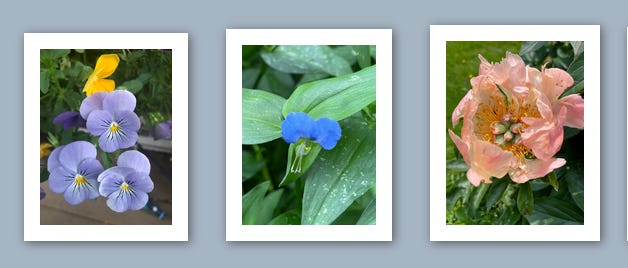
 A set of three photographed flowers, the first are lavender and yellow johnny jump-ups, the second is blue Asiatic Day Flowers, and the third is a wispy peach colored peony with fuzzy seed pods in the center. Inspiration from Artist Elizabeth Domogala's garden.

Johnny Jump-ups, Asiatic Day Flower and Peony from Elizabeth’s Gardens in New England. 

I’ll be painting these flowers in watercolor, then probably pastel or oil, turning them into coordinating motifs, art prints, note cards, and originals for spring. (If you’re curious which supplies I use, click here — affiliate links.)


a fabric fat quarter with small pastel blue and violet flowers in a basic repeating pattern
                                                            Pastel Blue & Violet Floral fat quarter Available here
an up close of the pattern named "Pastel blue & Violet Floral" basic repeat swatch of fabric with a pin in it.
 Pastel Blue & Violet Floral up close in cypress cotton canvas - a thick basketweave for a luxurious look and feel -HERE.

I will be composing two or three more floral patterns and some coordinates. Here is one above. 

The criss-cross you see above, along with the rest of the collection will be license-ready for multiple industries. If you are interested in licensing this or any of my collections, feel free to contact me here.

I love what I do — and I’m glad you’re here. Thanks for reading. (Back to my website HERE)
Monday, July 20, 2026

Beginnings Part 3: Dyslexia, Doodles, and the Power of STEAM

❇ How intuitive teachers saved my confidence, how a history doodle notebook almost cost me an A, and why the arts are essential life skills.

Fourth grade brought a major transition: moving from an intimate classroom of 17 students to a bustling room of 33. I struggled with reading and dyslexia, but my teacher, Mrs. Cooper, noticed my strengths. Instead of sidelining me, she opened the divider at the back of the room, fired up the opaque projector, and invited me to illustrate our lessons for the entire class. When she read to us about the favelas of Brazil during social studies, I traced and rendered the buildings in bold lines as she spoke. Imagining the people who lived there and what they did to earn money, I would add people to the illustrations. I could smell the foods they cooked and would add those dishes to the tables where families would sit together an eat. Fifty years later, I can still see that mural vividly in my mind and I can still tell you about the people of the favelas. 

By high school, art class was my sanctuary. Our teacher, Mrs. Beaupre, was remarkable. She taught us how to cut mats with clean beveled edges and frame our own work. She introduced us to soft pastels, charcoal, value studies, and perspective, insisting we measure our marks with precision. we painted on silk, etched copper plates, carved linoleum blocks, made monotypes, and drew portraits of one another. 

I poured so much energy into my art that my pre-algebra teacher asked me to stop by to see him after class. I was so worried I was going to flunk out of pre-algebra, I knew this meeting had to be the end, and my parents would be very disappointed. He actually aproached my desk after class and saw the look on my face. He quickly softened his voice and had a sweet smile as he said; "I went to the student art show and couldn't help noticing all of your amazing talent. How would you like to take two art classes and just skip pre-algebra altogether?" I told him thank you very much and then asked if that was possible and he said; "I already arranged it for you." He saw my face of disbelief and wonder at the same time and his sweet smile grew enormous and he let out a happy belly laugh! He was so happy to encourage me in the area of my strengths. I doubt that would fly today. Can you imagine if students today were encouraged to follow their interests? 

Academic classes, however, were not always so accommodating. One semester, my history teacher confiscated my notebook, forbidding me from "doodling" during his lectures. A method I used to take all of my notes - I drew my lessons so I could "see" them and better understand them. Drawing was how my dyslexic brain processed auditory information. Deprived of my visual anchor, my grade plummeted from an A to a D in that single marking period. 

Thankfully after a brief meeting with my father, my "doodles" were returned and I finished the semester with an A. Thanks Pops! 😎 

Intuitive educators understand that students arrive with innate, varied talents. it is a profound loss when we discourage those gifts in young people--especially visual and tactile instincts. 

Arts, trades, and hand-on crafts do far more than produce pretty objects; they cultivate focus, sustained observation, and critical thinking systems. Creative work forces the brain to slow down, think through challenges, quiet impulsivity, and truly examine the mechanics of the world. It gives young minds the time to ponder, wonder, and build resilience as they figure things out. 

We hear endless discussion about the necessity of STEM education, but science, technology, engineering, and math are incomplete with the arts. We need STEAM. the arts, humanities, and craft trades are the cultural bedrock of how human beings think, solve problems, and connect. 

As always, I appreciate you being here--thanks for reading! 

Monday, July 13, 2026

Beginnings Part 2, Fabric Bolts, Garage Breezes, and Learning to "See"

❇ From a Manhattan department store window elevator to salty art lessons in a beachside garage. 

My artistic education wasn't confined to paper and paint; it started with the makers around. During the '60s and '70s, my father dressed the display windows for major department stores along Fifth and Madison Avenues. I would help him on Saturdays, which was a dream for an imaginative child. Fun fact: the floors of the display windows in the Lord & Taylor Building were actual elevators! I got to press the big red button to descend to the warehouse floor and help my father pick out bolts of fabric and trims. Dad taught me all about draping, sketching, and cutting clean, square edges--something I still wrestle with today. 

Next door, our neighbor Molly was in in-demand draper for the NYC metro area. I still remember sitting on her lap at five years old, learning how to baste stitch as she gently guided my hand. She taught me how pattern and color interact, which fabrics suit drapery versus upholstery, how to pinch-pleat by hand using razor-sharp drapery pins, and above all, patience. meanwhile, my grandmother taught me how to embroider, crochet, ten a garden, and put up preserves for the winter--0skills she carried from her childhood in Italy and that I have since passed down to my daughter. 

When the weather warmed up at school, recess moved to the beach, and kickball took over the baseball diamond. while everyone else played ball, I was the kid wandering off toward the tidal pools, collecting hermit crabs, shells, and seaweed so I would have a fresh still-life setup ready to paint when I got home. 

Recognizing my obsession, my intuitive and resourceful mother tracked down an after-school art lass run by two sisters out of their garage near the shore. 

I can still smell the warm, salty breezes mingling with the paint, while hearing distant sounds of children laughing and playing at the beach. The warm mid-morning sunlight streamed in, casting dappled patterns across the long worktable. The sisters handed me watercolors, paper, and two brushes, giving me the simplest and most profound direction: "Paint what you see."

A tempura painting of a gray enameled pot with random utensils in it
Utensil in a Gray Pot, 
watercolor on butcher paper - age 7
It was the perfect instruction for my age. Void of rigid rules, I was free to explore shapes, colors, and the patterns from the dappled light hitting the table. One day, I painted an old, gray enameled pot filled with utensils.

I remember slipping completely into the "zone". No inhibitions, no anxiety about being judged--just the rhythm of the brush, the salt air and the dappled light. Those sisters ignited a genuine love of observational study in me that I still draw upon every time I sit down at my easel today.  

❇ Next up in Part 3: Overcoming dyslexia in the classroom, a memorable showdown with a history teacher, and why our kids desperately need the "A" in STEAM.


As always, thanks for reading.